An LCA Framework for AI Systems
For IT companies and anyone building AI as a core product — this one matters.
The International Telecommunication Union (part of the United Nations) has developed a lifecycle assessment framework built specifically for AI systems: ITU-T L.1801 — Guidelines for Assessing the Environmental Impact of Artificial Intelligence Systems.
In the absence of a standard, companies have been left to define their own rules — what to measure, where to draw system boundaries, which metrics matter. The result has been consistent inconsistency. Without shared guidance, comparisons between companies or products have been, at best, hazy. At worst, misleading.
L.1801 addresses that directly. It establishes cradle-to-grave lifecycle phases, treats training and inference as fundamentally distinct activities, and covers five environmental impact categories — going well beyond carbon.
In physical product sustainability, we've long started with ISO 14040/14044 or 14067 for LCA and product carbon footprints. Those frameworks give product teams the consistent foundation they need to drive decisions that lead to real outcomes — impact reduction, cost clarity, quality benchmarks. L.1801 is attempting to do the same for AI. That's significant.
What Is L.1801 and What Does It Cover?
AI System Classification
The framework classifies AI systems by model type, assigning different starting points based on their fundamental differences. Not all AI is the same — and the framework accounts for this.
Four Lifecycle Phases Defined for AI
L.1801 establishes four phases that map the full life of an AI model — from the physical hardware it runs on through to its eventual retirement:
• Hardware Materials & Manufacturing(Raw Material Acquisition): The upstream footprint of the physical infrastructure — chips, servers, data center hardware.
• Build & Train (Production): The energy, compute, and resource intensity of model development and training runs.
• Inference & Operation (Use): The ongoing environmental cost of the model in active use — every query, every output.
• Retire It(EOL): Similar to LCA's End of Life (EOL) phase — decommissioning, e-waste, and responsible disposal.
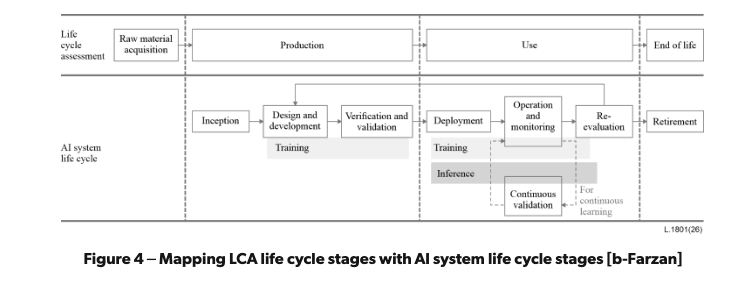
[Source: ITU Publication]
Five Environmental Impact Categories
Carbon is the required baseline — but L.1801 goes further, recognizing that AI's environmental footprint is wider than CO₂ alone:
• Carbon (GHG emissions) — Required
• Water consumption — Recommended
• Minerals & metals — Recommended
• Fossil fuel use — Voluntary
• Biodiversity Impact — Additional Consideration
Functional Unit & Comparability Requirements
The framework requires that a functional unit be established before measurement begins — a critical design choice that acknowledges the inherent variability of AI models and their implications across impact categories.
For results to be comparable across models or organizations, three things must align: the functional unit, system boundaries, and time horizon. L.1801 also defines a training allocation method and requires mapping of the downstream effects an AI system creates — capturing the impact it leads to, not just what it directly produces.
Opportunities and What Comes Next
L.1801 is not a complete solution — and the framework itself doesn't claim to be. It acknowledges real gaps: the data needed for allocation is not typically a publicly disclosed metric, there is currently no scalable method to measure AI's impact on biodiversity, and the framework is voluntary, not enforceable.
It is, however, a significant step forward, as one analyst aptly describes the pre-L.1801 as "the era of comparing apples to cars." That era is ending.

[Source: AI Finally Has a Report Card]
How L.1801 Can Drive Clear Outcomes
• Faster decisions driven by clear, comparable data across products and suppliers
• Identify Operational Efficiencies and cost savings (more efficient training models, lower power models)
• Supply Chain Transparency: standardized process for supplier evaluation
• Regulatory Compliance
• Eco-Design Inputs and Sustainable Claims Transparency
• Marketplace competitiveness: Meet increasing customer requests for product emissions measurement
• Track and measure progress against ESG goals with a consistent methodology
Why IT Companies Should Keep an Eye on This
The EU AI Act is already creating the regulatory context in which L.1801-style methodologies could be applied — and eventually enforced. Technical teams that get ahead of this now will have a cleaner path to compliance later. That's not a small advantage.
The question isn't whether AI's environmental footprint will be measured. It's whether your organization will be prepared when it becomes the expectation — or the requirement.
Sources
Framework Summary → https://lnkd.in/gFZvfH9k
The White Paper → https://lnkd.in/gMcq_Mwf